lies that limit language learning
Alliteration is so fun.
Alternative title: my pet peeves
For 10 years now, I've cycled through phases of learning Japanese, Chinese, and Korean. Amazingly, 2026 marks a decade of consuming Chinese culture. I’m so used to seeing Chinese characters and I know pinyin perfectly, but I’m still not fluent in the language. :(
My main language of study in college was Japanese. I took it for three and a half years and even took a Japanese linguistics class. TAUGHT FULLY IN JAPANESE.
By all accounts, I should know both Japanese and Chinese near fluency at this point. I can tell you everything about the sociolinguistics of Japanese dialects, but I’d have to explain it to you in English.
But that is exactly what a linguist is: we can describe the concept of language, but more often than not, we can't speak a ton of them fluently. That is a polyglot. Sometimes they're referred to as multilinguals.
In some parts of the world, speaking multiple languages is normal and expected, often due to colonization or simply globalism. Simultaneous bilingualism is the norm in most parts of Africa and India, for example. You learn the local language, the colonizers’ language, and sometimes a third language is thrown into the mix. My parents never had to learn English when they moved to the US from Africa. The only learning they had to do was adapting to Midwestern American English and shedding the remnants of their native British English.
Polyglots on Social Media
Multilingual content is incredibly popular online right now, especially on short-form platforms like Reels, TikTok, and YouTube Shorts. In the videos, creators will walk up to locals and say, “I can speak your language,” then proceed to rattle off the most rehearsed phrases you’ve ever heard -_- . I mean, at the end of the day, all you really need to do is convince the camera that you’re fluent.
These videos bring in massive views. You get major bonus points if you look completely different from the native speakers of your target language.
A white man in Japan? Been there, done that, yawn. But a Black man? WOW! Or a white person in India or Pakistan speaking Hindi or Urdu. There is a massive contrast in appearance between a blonde New Zealander and a Southern Indian, and that contrast prints views.
There is nothing inherently wrong with this kind of content; I will happily watch Karl Rock any day of the week, 10/10 recommend his channel. But some other cultural/language videos are misrepresentations or straight-up engagement bait.
I cannot for the life of me find the clip now, but I remember Jerry in China, a Black man living in China posted a video of his interaction with locals. I believe he was in a place like Fuzhou, where they don't speak standard Mandarin. The translation in the video made it seem like the local man was being rude or saying something racist. In the comments, people said that Jerry mistranslated the local man's words. I wouldn't know, but whether it's intentional or not, it made me weary of those kinds of videos. Although I love his smile, so I don't really care.
I also recall watching this native Tamil speaker, probably around 18 years old, claiming he was a "hyper-polyglot" (which is just a fancy word people use to say they can speak more languages than most people can name).
In the video, this so-called hyper-polyglot speaks briefly in 46 different languages, falsely claiming fluency and proficiency in many of them. And people fully believed him! Because he’s a linguistics student, he knows a few psychological tricks. Speaking quickly and gesturing heavily with his hands works wonders for projecting confidence.
I’m only fluent in English, but aside from his barely understandable English sentences, I could tell he was bullshitting several of the other languages too. He was likely speaking fast just to recall the raw phonetics of the words as quickly as possible before his memory slipped.
I actually did this exact same trick last year on TikTok. It was supposed to be an obvious joke, but some people genuinely believed me. Essentially, I bullshitted the English captions and copied Google Translate text-to-speech audio right before recording each language, except Chinese, which was poorly improvised. It’s incredibly easy to pull off. It took native speakers in the comments to point out that the whole video was satire.
Here are a few examples of what the video was like:
- Spanish: "La biblioteca cierra en dos minutos más o menos."
- My English caption: "Spanish is one of the easiest languages."
- Actual translation: The library closes in about two minutes.
- Mandarin: "我想学中文,所以我去中国的时。。。我有一个帅中国人的男朋友" [botched language skills, i know]
- My English caption: "Chinese is a very complex language. I really like it. I studied it for 10 years."
- Actual translation: I want to study Chinese, so when I go to China… I have a handsome Chinese boyfriend.
- Tagalog: "Gwapo ang mga lalaking Pilipino."
- My English caption: "Filipinos never disappoint, they're so funny."
- Actual translation: Filipino men are handsome.
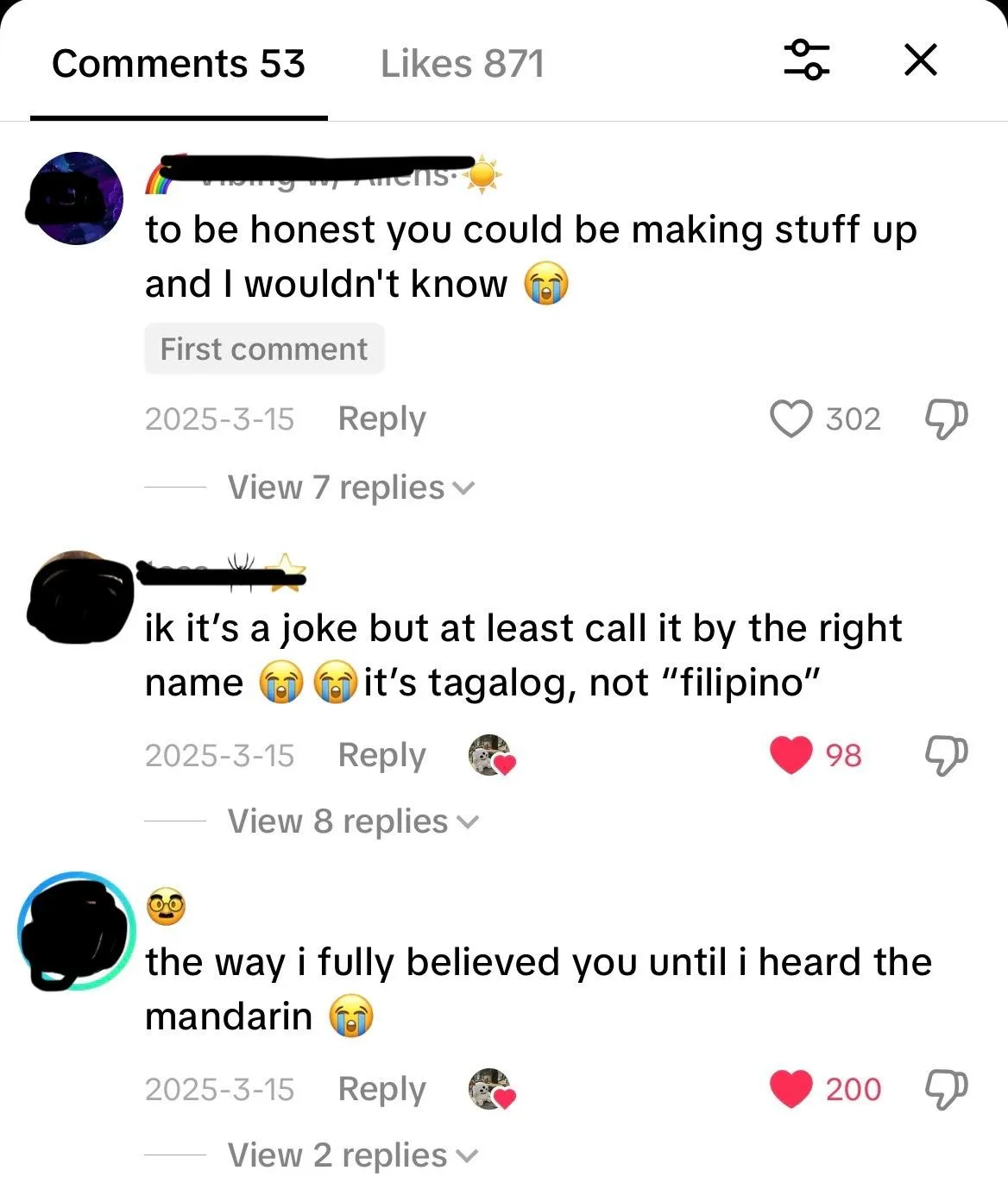
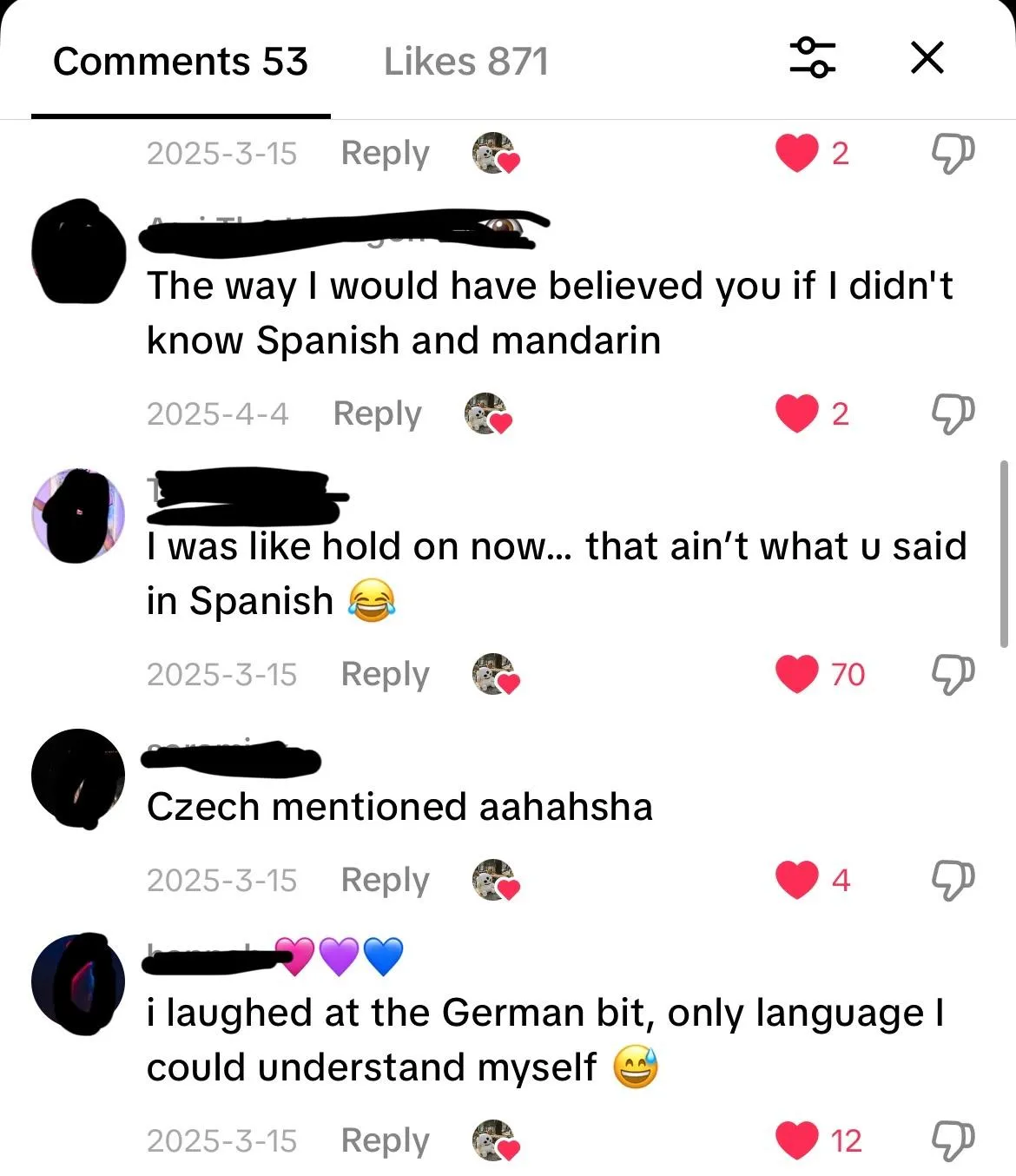
In the grand scheme of things, it's harmless. I just like to complain.
Misunderstanding "Learning by Osmosis"
You know what else really grinds my gears? Language learning content creators talking about "natural immersion" or "learning like a child."
YOU ARE NOT A CHILD! This is so misleading.
The reason you can drop a Romanian baby in the middle of China and have them become fluent is because they start with a blank slate. There is no "L1" (first language) when you come out of the womb.
Think of it like a sponge. A brand-new sponge is dry and full of potential. It soaks up water slowly until you hit post-puberty. That water is your L1. Once that sponge is completely saturated, there's no more room to simply "absorb" another language to fluency. You're grown now. You have to study. You need a whole separate sponge at that point, also known as your L2. This is especially true when you don't live in a country where your target language is spoken.
(btw, using the same analogy, those with simultaneous bilingualism absorb a water and juice mixture. Equally soaked up by the sponge.)
When people say "immersion," we mean consuming content at your level (comprehensible input). You cannot sit and watch anime with zero subtitles and expect to magically learn Japanese (ignoring the fact that anime Japanese is highly unnatural in the real world anyway).
The "like a child" thing only works if you copy the level of the content children consume. Watching Peppa Pig in Chinese is fantastic for beginners. Expecting to learn Chinese by watching a dramatic dating reality show is not so fantastic. But if you're watching a 20 second Youtube Short, they will not elaborate on why they're watching a Chinese reality show for language learning. Probably because they're at a C1 level. Or they're lying.
You also have to be active in your learning. There are plenty of immigrants in every country who stick solely to communities that speak their native language and never learn the local tongue. I’ve seen so many Western "expats" in Asia who are married to local women and have lived there for years, yet still cannot speak more than a surface level of the language because they only hang out in English-speaking circles. They have the perfect environment for rapid language learning but say they're "too old." without trying. Brother you're only 30, you must try goddamit!
How to Actually Frame Language Acquisition
Language learning does not come easily to most people, which is why actual polyglots are so impressive. But relying on a pop-science understanding of language acquisition will only slow your progress down. To be clear: it’s nobody’s fault for not knowing how this stuff works. That is exactly why you should look to actual proven language learning methods backed by research rather than language influencers. Influencers do what works for them. Linguistics gives you a toolbox to figure out what works for you.
For example, people on the autism spectrum might struggle with tonal languages or languages with heavy stress patterns, so their approach might need to be much more visual and auditory compared to someone who excels at tone but struggles with reading.
I know exactly what works for me; I'm just lazy. After getting my degree, I knew precisely how I needed to study. Personally, I can mimic sounds incredibly well, but I struggle heavily with listening comprehension. It's a fascinating contrast, because many of my non-native English-speaking friends can comprehend spoken English perfectly, but struggle to speak it back.
We are all wired differently, after all.
In general, stay away from Duolingo and get a physical textbook from Amazon.